Appraising the Millennium Falcon: Meet the Specialists Who Put a Price on Your Brick Life
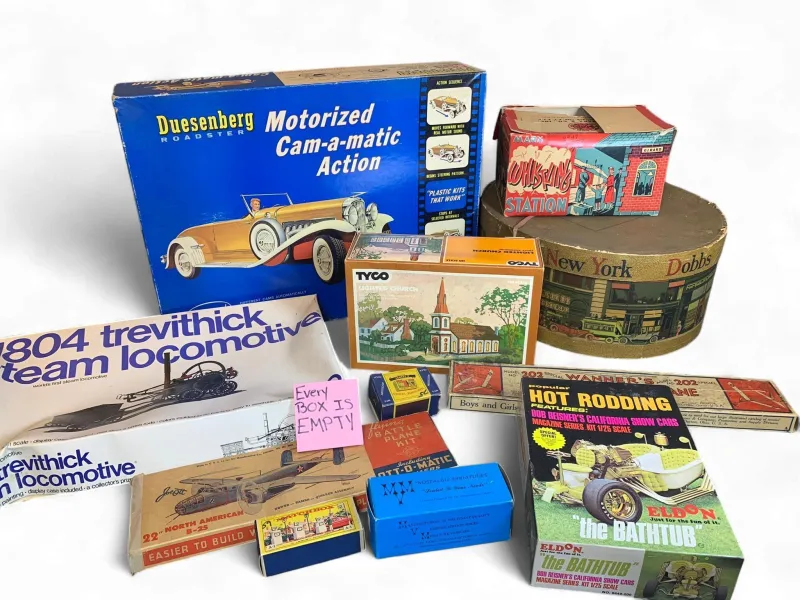
Photo: vintage collectible toy boxes on shelves appraisal, via bidspirit-images.global.ssl.fastly.net
Most people's estate plans cover the house, the 401(k), and maybe grandma's china. Then there are the clients who slide a photo across the desk and ask, very quietly, what happens to the collection.
Not the cars. Not the coins. The eleven shelves of boxed sets in the basement, the tubs of sorted parts color-coded by a system only one person alive understands, and the single loose minifigure currently insured for more than the family sedan.
Welcome to the niche world of brick-adjacent professionals — the mediators, appraisers, and estate planners who've discovered that America's favorite building toy is also one of its most contested assets.
The Appraiser Who Learned the Hard Way
Dana Okafor didn't set out to become one of the country's go-to valuers of plastic. A general antiques appraiser outside Columbus, she took a garage-sale lot to a specialist friend on a lark and learned that the beat-up yellow box in the photo was a first-run Galaxy Explorer — and worth roughly the same as a used transmission.
"I nearly priced it at twenty bucks," she laughs. "That's the thing about bricks. Condition, completeness, whether the instructions are there, whether the box has a crease on one corner — a crease can be four hundred dollars."
Now a chunk of her practice is sets: retired themes, sealed vintage boxes, and the occasional minifigure whose value hinges on a fraction-of-a-millimeter difference in torso printing. She's testified in two divorces and one bankruptcy proceeding. In the bankruptcy, a sealed vintage Star Wars set — appraised north of $12,000 — was treated by the court like any other collectible, right down to the question of whether the debtor had undervalued it on their asset schedule. (They had. That did not go well.)
"Emotional Assets" Are Real, and They're in the Settlement
Here's where it gets stranger than valuation. In high-conflict divorces, some family law mediators have started treating certain items as what they informally call "emotional assets" — pieces whose monetary value matters less than what they mean.
The classic scenario: a couple built a massive display together over twenty years. Neither wants it. Neither wants the other to have it. Selling it feels like dividing a photo album down the middle with a bandsaw.
Mediator Rachel Tran, who works in the Pacific Northwest, handles these cases by doing something almost nobody expects: she makes the couples build.
"I put a pile of parts on the table and ask them each to build the marriage," she says. "It sounds like a gimmick. It is a gimmick. It's also the only hour in six months of litigation where both of them talk about something other than money."
Outcomes vary. Some couples split the collection by theme — one takes the castles, one takes the space stuff. Some agree to joint custody of a single grail set that lives with whoever has the display room, with visitation negotiated in writing. One settlement Tran mediated included a clause granting the ex-husband first right of refusal if the wife ever sells a specific vintage pirate ship. It's legally binding. It's also, she admits, "the most sentimental contract clause I've ever drafted."
Estate Planning Gets a Spreadsheet
On the other end of life, estate planners are quietly adapting too. A generation that grew up with bricks in the '70s and '80s is now writing wills, and their adult children are frequently clueless about what's in the attic.
"The single worst outcome is the estate sale where a $5,000 lot goes for $75," says one planner who asked to remain unnamed because his firm hasn't formally advertised the specialty. His advice to clients is unglamorous: photograph everything, print current price guides, and tape a one-page summary to the inside of the storage cabinet.
"Your heirs don't need to be fans," he says. "They just need to know not to have a yard sale before calling somebody."
Some planners go further, recommending clients designate a "brick-literate" friend or fellow collector as a named consultant in the will — someone who can identify the good stuff before the family donates it. In one documented case, a will simply read: "Call Dave about the basement. Dave will know."
Dave knew.
What Your Collection Is Actually Worth (Probably Less, Occasionally More)
For the curious: most collections are worth far less than owners think, and a rare sliver is worth far more. Loose modern parts are basically bulk goods. The money lives in sealed vintage boxes, complete retired sets with instructions, and error minifigures — misprints and variants that fetch jaw-dropping sums from specialists.
Appraisers' rules of thumb:
- Boxed and sealed beats built and loved, almost always. Sentiment doesn't transfer to the market.
- Completeness is king. A set missing two pieces can lose half its value; the original box can double it.
- Documentation matters. Receipts, photos, and purchase dates turn "I think it's old" into a defensible valuation.
- Never let a spouse's divorce attorney be the first person to price it. By then, you've already lost leverage.
The Human Part
For all the spreadsheets and sworn testimony, everyone we spoke with circled back to the same thing: bricks are memory made physical. That's why the fights get so heated, and why the resolutions that stick are the ones that honor the feeling, not just the figure.
Tran keeps a photo on her office wall of two siblings — adult siblings, mind you — who spent a contested inheritance mediation building a small lighthouse together, one brick at a time, in her conference room. They split the collection the next day in forty minutes.
"Nobody frames a settlement agreement," she says. "But his daughter has that lighthouse. So does hers. They built two."
That, more than any appraisal, might be the real value of the collection.