Shelves That Run the House: When Brick Displays Become the Interior Design
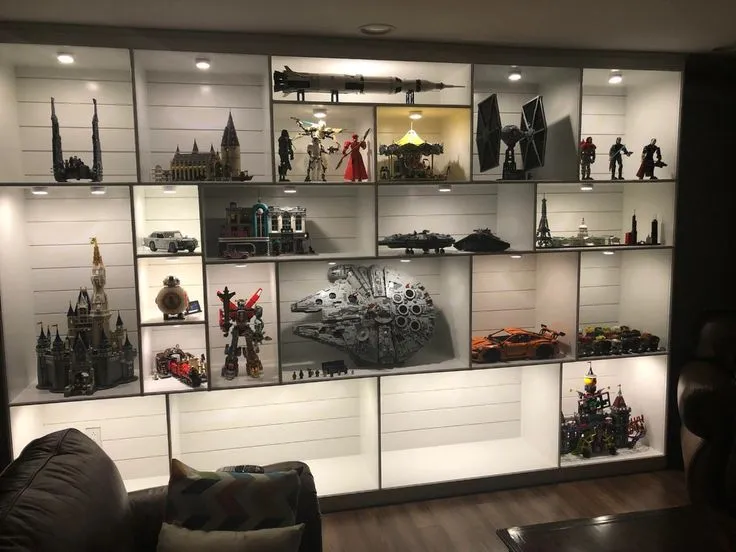
Photo: LEGO display shelves living room interior design, via i.pinimg.com
There's a moment that happens in a certain kind of American home. You walk in, you compliment the space, and your host says, 'Thanks — wait till you see the hallway.'
The hallway, it turns out, is shelving. Floor-to-ceiling, LED-lit, dust-magneted shelving, holding a few hundred builds that took years to accumulate and one very patient spouse to tolerate.
Welcome to lego-core: the interior design movement nobody planned and everybody's arguing about.
The Living Room Is a Vitrine Now
Ask around and the pattern repeats. The collection starts in a spare room. Then it migrates. A display case appears in the living room 'temporarily.' Two years later, the entertainment center is gone, the TV hangs above a modular building skyline, and nobody in the household remembers when it was otherwise.
'It just happened,' laughs Dana Whitfield, 41, of Columbus, Ohio, whose open-concept main floor now features a twelve-foot run of floating shelves devoted entirely to her family's builds. 'We kept telling ourselves we'd get a proper console. Then we realized the builds WERE the console.'
Dana's setup is what collectors call 'curated chaos' — color-blocked groupings, a few retired sets she'll never open, and one shelf reserved for whatever the kids made that week. It shouldn't work. It absolutely does.
Five Homes, Five Philosophies
We toured five setups across the country, and no two approach the problem the same way.
The Brooklyn Apartment (470 square feet). Marcus Lee built his displays into the architecture itself — recessed shelving between wall studs, glass fronts to fight dust, and a lighting strip that makes his modular buildings glow at night like a tiny, obedient city. In a rental, every screw hole is a negotiation with a landlord. Worth it, he says.
The Texas Ranch House. Everything is bigger: a dedicated 'build wall' in the den, a staircase lined with floating shelves, and a garage annex for overflow. The homeowner, a retired contractor, calls it 'the only renovation my wife and I never fought about.'
The Minneapolis Duplex. Here, the display IS the divider. A double-sided glass cabinet splits the dining and living areas, visible from both rooms and from the street through the front window. Neighbors wave. Some stop in for the tour.
The Portland Craftsman. The philosophy here is restraint: one cabinet, one shelf, rotating displays like a museum with a six-week exhibition schedule. 'If everything's out, nothing stands out,' the owner told us.
The Arizona New-Build. These homeowners designed the house around the hobby — a stairwell nook with integrated lighting and outlets for display cases. The builder thought they were joking. They were not.
A Designer Weighs In
Interior designer Priya Raman, who works with collectors in the Chicago area, has seen both sides of the debate. Her take: the difference between lego-core and clutter is three things.
'Negative space, lighting, and cohesion,' she says. 'Leave breathing room between displays so each piece reads. Use consistent lighting — warm LED strips, not whatever flashlight came in the drawer. And pick a color story, even a loose one. A rainbow wall is a choice. A random wall is just a wall.'
She also has opinions on the furniture itself. 'Skip the flimsy cube organizers. If you're going to make this the focal point of your living room, treat it like art. Solid shelving, anchored to studs, glass where dust is a problem.'
Dust, for the record, is the great enemy. Every homeowner we spoke to mentioned it unprompted. Solutions ranged from annual deep cleans to a Florida collector who swears by a paintbrush reserved solely for brick duty.
The Great Debate
Not everyone's on board. Reddit threads and Facebook groups light up regularly with the question: is a wall of plastic builds a design statement or a cry for help?
The anti-display camp argues that lego-core reads as 'unfinished' to guests — a hobby that never got put away. The pro camp counters that nobody says this about vinyl records, sports memorabilia, or the taxidermy in your uncle's den.
Whitfield has a pragmatic answer. 'People who come over and love it, love it. People who don't, don't. My house isn't for them.'
Build It Like You Mean It
If you're ready to let the collection out of the basement, the consensus advice is simple: start with one wall, commit to lighting, and anchor everything properly. Floating shelves rated for real weight, glass fronts in dusty climates, and a rotation plan so the display stays a living thing instead of a monument.
Because the best brick rooms aren't frozen in amber. They're still being built — one shelf, one set, one very patient household at a time.