Forty Bucks, One Garage Sale, and the Mosaic That Put a Town on the Map
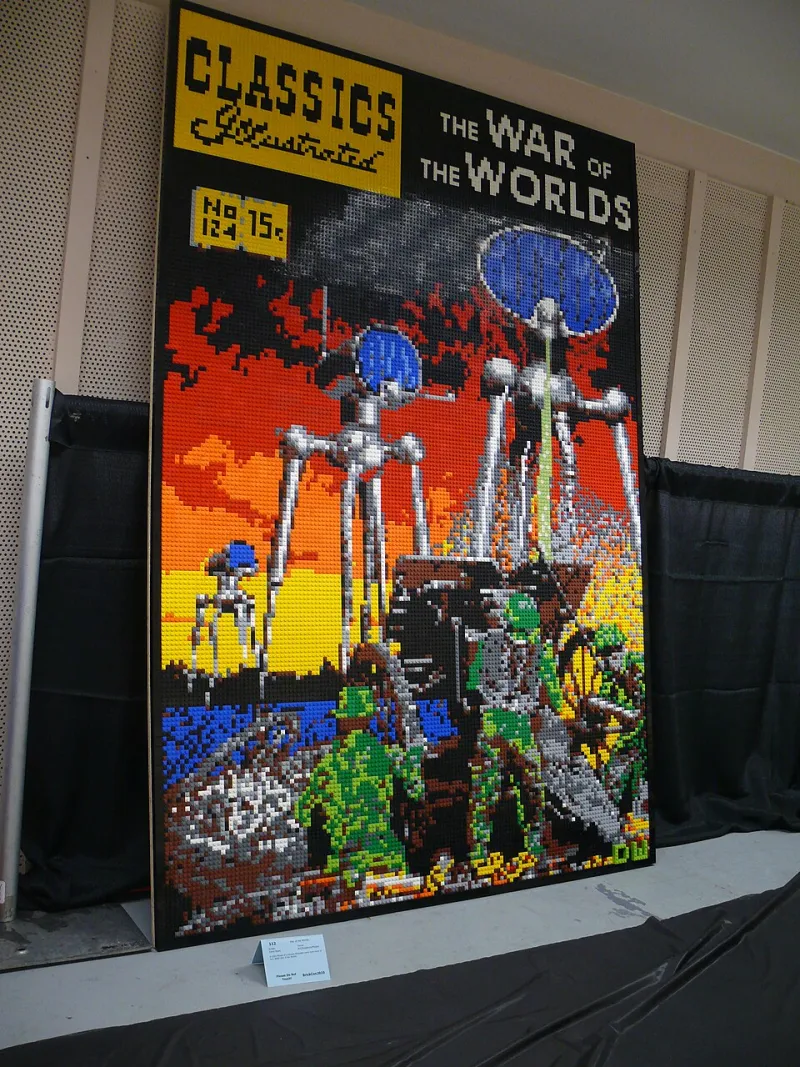
Photo: Bill Ward from El Cerrito, CA, USA, CC BY 2.0, via Wikimedia Commons
The Bin Nobody Wanted
Every Saturday morning from April through October, Dave Kowalski does the same thing thousands of other Americans do: he hits garage sales. The difference is what he's hunting for. While everyone else rummages for vintage tools or old records, Dave heads straight for the saddest box on any driveway — the one full of mismatched, dust-covered plastic bricks that a family is desperate to get out of the house.
"People practically pay you to take them," he laughs. "You'll see a bin that represents somebody's whole childhood, and the sign says five bucks or best offer. That's a treasury if you know what you're looking at."
Dave's most famous haul cost him $40 at an estate auction two towns over. Four banker's boxes of unsorted bricks, no instructions, no sets, just a jumble. Today, the centerpiece of what he built from that jumble hangs in the lobby of Millbrook's public library, where roughly 600 residents pass it every week.
Reading a Mystery Box Like a Pro
Ask Dave how he spots value in a bin of chaos, and he'll talk your ear off. His method has evolved over eight years and roughly 90 garage sales, and it boils down to a few principles any thrifting brick fan can use.
First, weight. Quality bricks have heft. If a box feels dense when you lift it, that's usually a good sign — lots of pieces, and probably some baseplates hiding at the bottom. Baseplates alone can be worth the price of admission, since they're the foundation of any large mosaic project.
Second, color inventory. Dave does a quick ten-second scan before buying. "I'm not looking for specific sets. I'm looking for a spread of colors. Lots of white, black, gray, and red? That's a portrait waiting to happen." For mosaic work, monochrome-heavy lots are gold; a rainbow assortment is better suited to freeform builds.
Third, don't dismiss the dirty stuff. A quick bath in warm water with a drop of dish soap brings most dusty bricks back to life. Yellowed white pieces can often be revived with a peroxide bath — a trick Dave learned from online restoration communities.
What he skips: heavily sun-faded pieces, anything cracked, and bins dominated by off-brand bricks that don't clutch well. "If the pieces don't grip each other, you've bought plastic confetti."
From Driveway Junk to Lobby Landmark
The library mosaic — a rendering of the town's 1912 water tower against a sunset gradient sky — took Dave about five months of evenings in his garage. He worked from a pixelated photograph, translating the image into a grid where each brick represents a single pixel. The finished piece measures roughly four feet by six feet and consumed an estimated 9,000 pieces, most of them sourced from driveway sales across three counties.
The technique, sometimes called brick mosaic or pixel art building, doesn't require rare sets or expensive kits. What it requires is volume and patience. Dave estimates his water tower cost him under $100 in total materials — a figure that makes gallery owners wince and garage sale hosts nod approvingly.
When the library unveiled the piece, the local paper ran a photo on the front page. Kids started bringing Dave bricks they found in their basements. A retired teacher dropped off two shoeboxes of 1980s-era pieces she'd been storing since her own kids left home. "That's the part I didn't expect," Dave says. "The mosaic isn't really mine anymore. It's the town's scrapbook, built out of everybody's leftovers."
The Pipeline Is Bigger Than One Guy
Dave is hardly alone. Across the country, a quiet network of builders treats secondhand bricks as an art supply aisle. Estate auctions, church rummage sales, Facebook Marketplace lots, and Goodwill bins all feed the pipeline. Some builders specialize in mosaics of local high school mascots; others do memorial portraits commissioned by families.
The appeal is easy to understand. New brick sets are expensive, and large-scale art built from retail-priced pieces can run into serious money. Secondhand lots flip the economics: what costs a family $200 new might sell for $25 in a bin on a driveway in Dayton.
There's also something deeper at work. Every brick in Dave's mosaics has a previous life. A piece that once belonged to a kid's castle in 1994 now forms a cloud in the water tower's sky. "I like to think I'm not recycling plastic," he says. "I'm recycling playtime."
Tips for Your First Mystery Bin Build
If Dave's story has you eyeing your own neighborhood's garage sale season, he offers this starter advice:
- Start small. Your first mosaic should be maybe 16 by 16 studs — a single face or simple icon. Save the four-footers for later.
- Sort by color, not shape. For mosaics, shape barely matters. Color is everything.
- Use a grid program. Free online tools can convert any photo into a brick-friendly pixel map, telling you exactly how many of each color you need.
- Buy the boring bins. The box of all-gray bricks nobody wants is more valuable to a mosaic artist than a partial licensed set.
- Build in public. Dave sorts and assembles at the library on Saturday afternoons. Half the fun, he says, is watching people realize what the pile is becoming.
Dave's next project is already in progress: a portrait of the retired crossing guard who worked the corner of Main and Elm for 31 years, built entirely from bricks donated by the students she once waved across the street. The bricks, of course, came from garage sales too. "Somebody's junk drawer," Dave says, "is always somebody else's masterpiece waiting around."
His next sale stop is tomorrow morning. He'll be there when the doors open.